Autumn, by the Handful
Field notes from the Festival of Fruit at Piper’s Orchard
By Edward Krigsman
A plump apple fills an outstretched hand. Behind it, bells jingle and wooden sticks clack as the Morris dancers strike up. Nearby, the wet squish of crushed fruit accompanies the cider pressing.
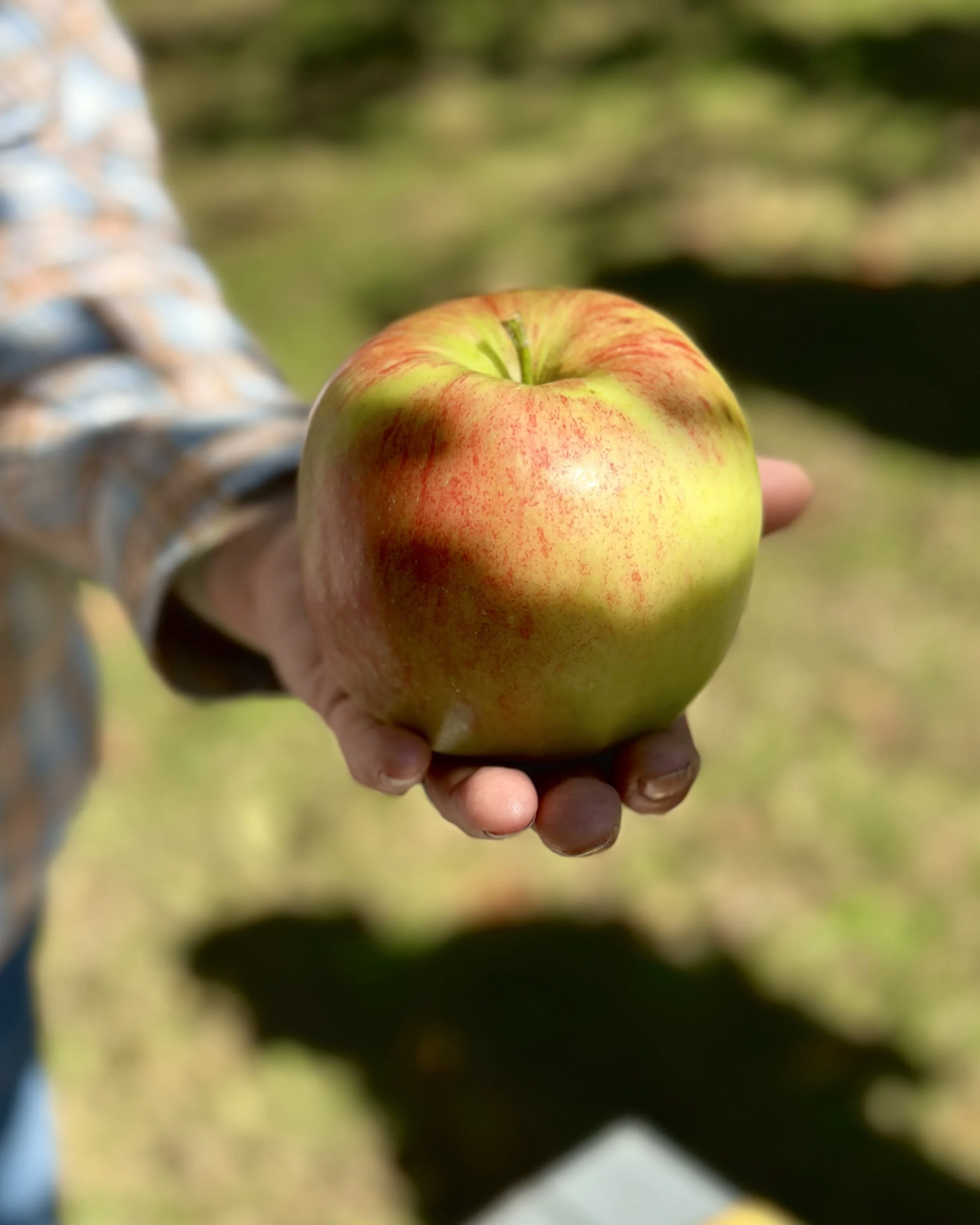
Autumn, by the handful: a Jonagold catches the light at Piper’s Orchard.
Few foods are so closely associated with Washington. But here at Piper’s Orchard, an apple comes with stories you won’t find on a grocery label: who planted the tree, who rescued it from blackberries, who knows its name, and who has been waiting all year for another taste.
Planted by the Piper family in the 1890s, this historic orchard survives within the woods of Seattle’s Carkeek Park, cared for by volunteers. Its annual Festival of Fruit brings that living history into a celebration of picking, pressing, tasting, music, and dance. This year’s seventeenth gathering took place on October 4. pipersorchard.org
Power of Place producer Orion Brown and I brought our Story Booth—a place to pause at a microphone and share a memory, a favorite flavor, or a connection to the orchard. Visitors brought their own histories; children were making new ones. Later, I took one of our microphones out among the trees, collecting conversations and the sounds of harvest.
With a microphone, the orchard revealed another kind of abundance: the buzz of children climbing and playing, visitors trading stories, the little pop of an apple coming free from its branch. Together, these sounds suggested a living agricultural museum—one where you could taste the history and add a story of your own.
Listen: A moment in the orchard
Children at play, conversations beneath the trees, and the sounds of harvest.
There was plenty to feed our curiosity—and our appetites.
Sweet, tart, crisp, juicy: tasting apples side by side makes a familiar food surprising again. Then there was the delicious, freshly pressed cider everyone got to help make. Orion’s son Ocean was especially taken with it. The old press offered both refreshment and a reason to gather, watch, and have a turn.
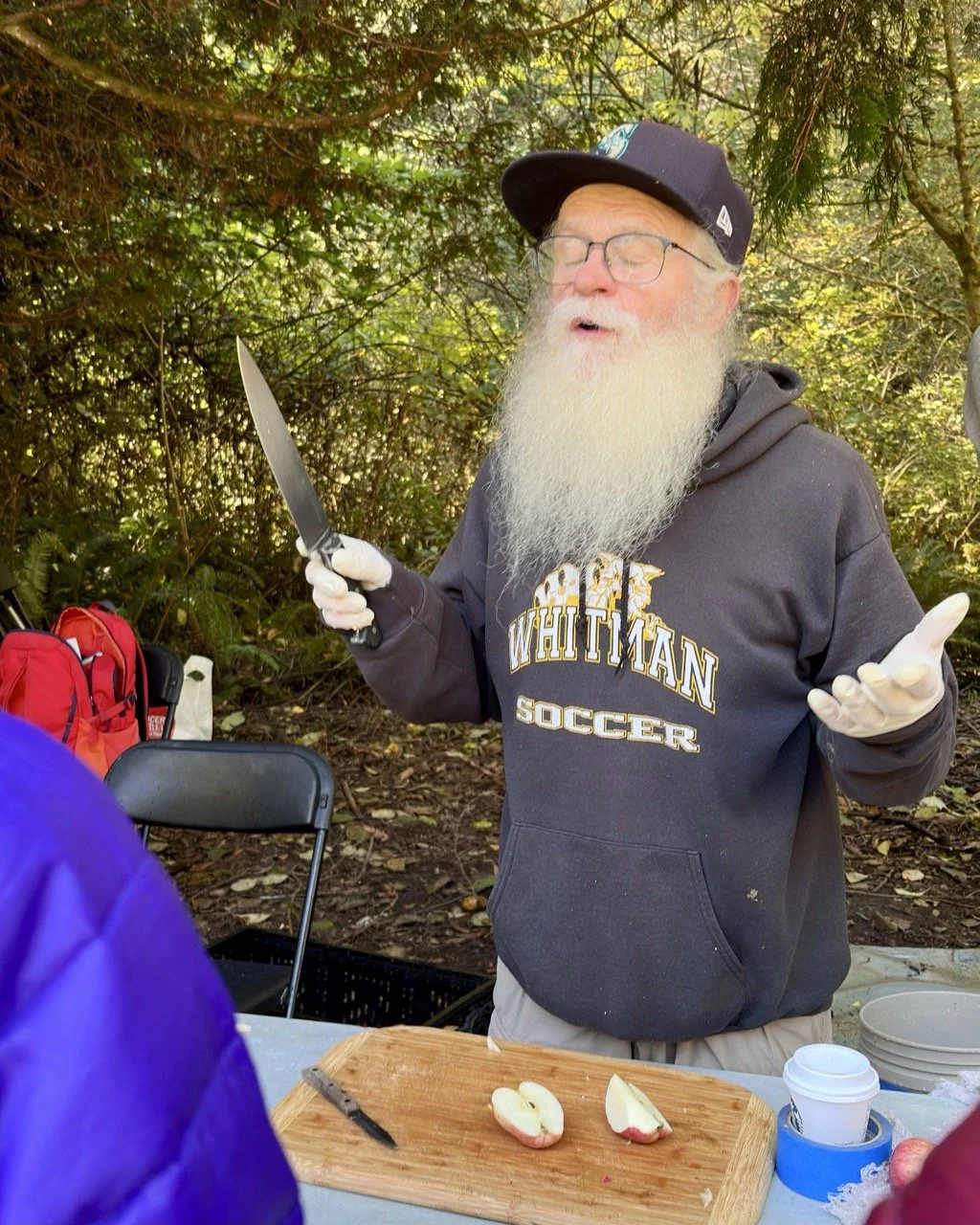
One apple, many opinions. At the tasting table, familiar fruit offers fresh surprises.
Weathered wooden orchard ladders stood ready for the harvest. Long picking poles, fitted with bright orange catchers, put fruit from the treetops within reach. On a clothesline, an apple in a child’s drawing wore a crown and extravagant purple boots.
The Morris dancers brought their own contribution to the harvest. Their leader introduced the performance as a ritual for encouraging the orchard’s fertility—a spirited wish for harvests still to come. Ribbons flew, bells sounded, and sticks met with a satisfying crack. Among these old, fruit-laden trees, the celebration felt entirely at home.
Bells, music, and the crack of wooden sticks: Morris dancers bring a spirited wish for future harvests to Piper’s Orchard.
At the Story Booth, Scoutmaster Jensen Curley told us about visiting with his Outdoor Service Guides youth group. A returning visitor and occasional orchard volunteer, he offered an admirably uncomplicated answer when I asked about his favorite apple here: whichever one was in his hand.
For everyday family eating, he had a more specific choice.
“Probably the Cosmic Crisp. They don’t brown so we can cut them up for the kids and they stay good for a long time.”
And what did the children love about the orchard?
“Climbing the apple trees that are all crazy, falling over and keep growing.”
One remarkable tree had, in Jensen’s words, “gone feral”: roughly thirty feet of trunk snaking along the ground before rising into a towering section, perhaps forty feet high, still resplendent with apples. Children clambered over its sprawling form. Here was living history they could climb.
Beneath a lovely Golden Russet tree, apple-identification expert Lori Brakken welcomed visitors with fruit from their own backyards and questions about what they were growing.
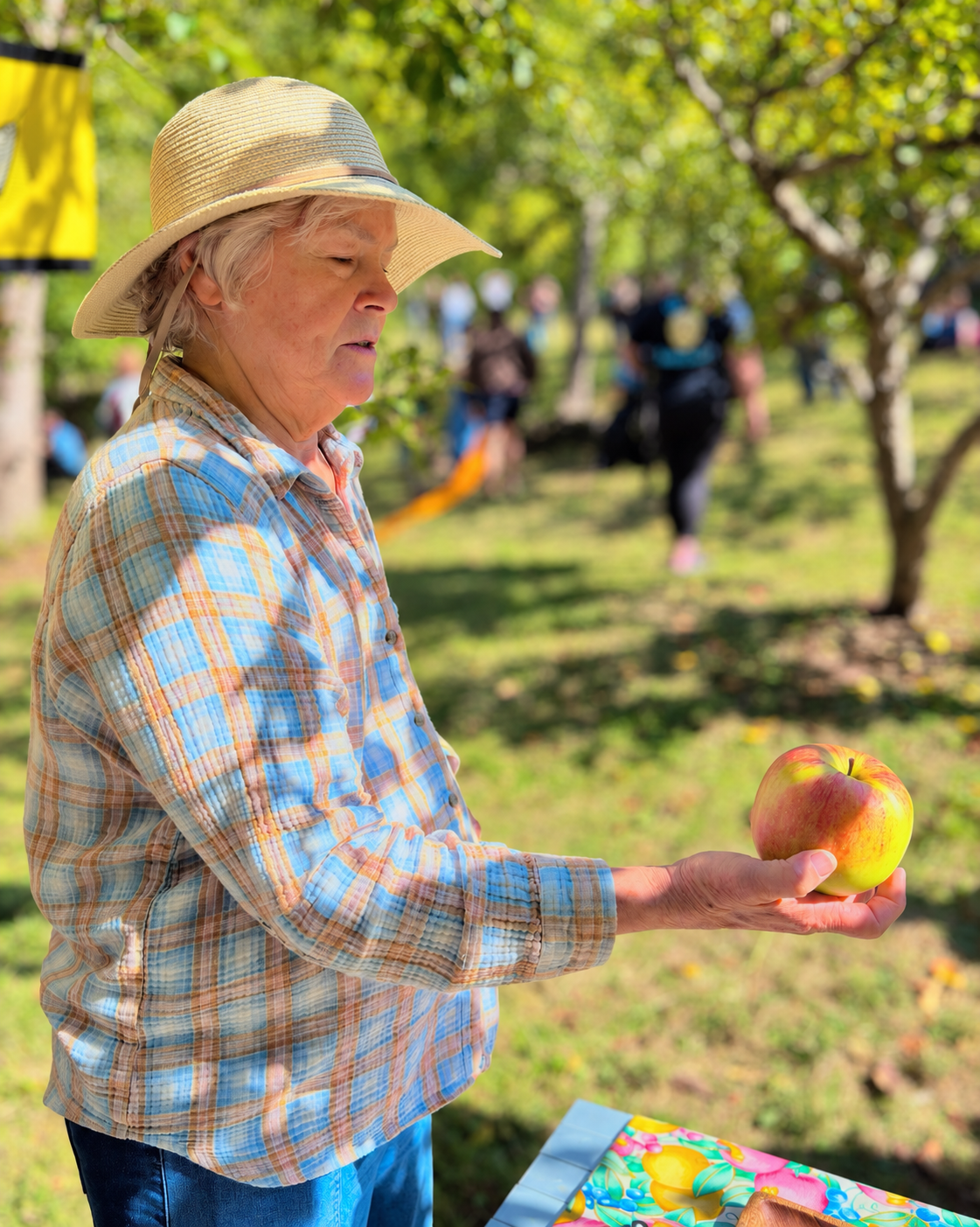
Lori Brakken examines a visitor’s Jonagold, finding clues to its identity in its stem, ripening season, and bands of color.
“The Rhode Island Greening is wonderful,” she told us. “The Golden Russet that we’re standing underneath is a lovely apple.”
Choosing a favorite wasn’t simple. As Lori put it, “They each have their moment when they’re their best.”
She held up one particularly handsome apple.
“Isn’t this beautiful?”
Someone had brought it from their yard. It was a Jonagold. Lori explained how she arrived at its name: its long stem, when it ripened in Seattle, and the bands of color that appeared as September progressed. She had asked the grower when the striping began; the answer was another clue.
The grower had also protected the apples individually with little coverings called “foot socks.” This large, handsome apple represented a season of someone paying attention.
Looking at apples with Lori meant noticing color differently. She pointed out the pale coating called bloom, describing how it could reflect the sky and make a red apple appear blue-purple on the tree. Beneath the branches, familiar fruit became something worth examining all over again.
The Golden Russet overhead prompted a story reaching far beyond Seattle. Lori described apples carried across the Atlantic in barrels, their seeds planted after the crossing, and generations of fruit connecting American orchards with European ancestors. Standing beneath this tree, we were invited to imagine those journeys continuing into the orchard around us.
Her work also follows journeys closer to home. Visitors arrive with a simple question: What is this apple? Sometimes, Lori explained, that question begins a relationship. She may visit a tree when it blossoms, then help its owner think about protecting the following year’s fruit. An identification becomes a conversation that continues through the seasons.
For Bob Baines, the orchard brought back memories of branches almost lost beneath blackberries.
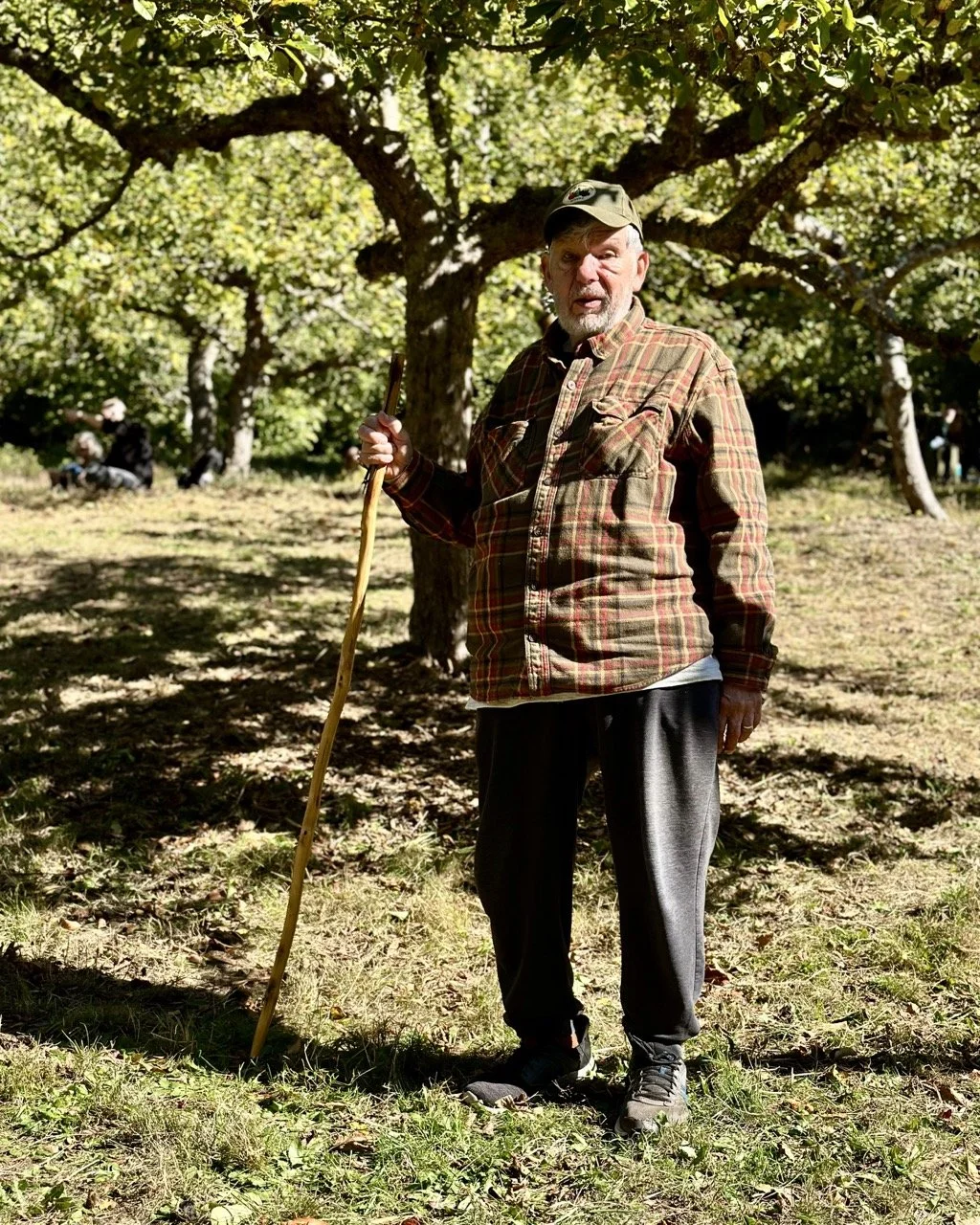
Bob Baines beneath the trees he helped restore—a living orchard once nearly lost to blackberries.
Bob worked for Seattle Parks for about 37 years. He was an arborist when he became involved in the orchard’s restoration, after Daphne Lewis rediscovered it and helped bring people together to recover it.
When she first showed him the trees, blackberries reached through their tops, some thirty or forty feet above the ground. Bob remembered telling her he was interested in fruit trees, but less interested in blackberries.
“Call me when they’re gone.”
About a year later, the call came.
Bob helped bring the overgrown trees down to a size that could be managed and harvested. Listening to him, the restoration became a series of particular tasks: branches cut, work parties assembled, people finding ways to contribute what they knew.
His affection extends to particular apples.
“My favorite is Gravenstein.”
He described tending a collection of Gravenstein trees at a demonstration garden in Mount Vernon. Even after a career working with trees, there were favorites worth returning to, season after season.
At Trent Elwing’s table, attention turned toward a much smaller orchard inhabitant.
Trent demonstrated the care of mason bees, showing visitors nesting materials and cocoons while explaining the preparations that connect autumn work with spring blossoms. There was laughter around his description of pollen collection, along with close examination of the little structures in front of him.
He had brought apples from his own backyard orchard in Port Orchard, too. Some bore bird pecks or other blemishes. He pointed out what had happened to the fruit and talked about what could still be enjoyed.
Knowledge and apples passed across the table together.
Longtime volunteer BJ Hedall recalled clearing blackberries and described a photograph she still has of people standing on the hillside after a work party. Her involvement with City Fruit points toward a story extending beyond this afternoon’s harvest: caring for urban fruit trees and sharing their abundance through food banks, meal programs, and other community partners. www.cityfruit.org
BJ Hedall, at left, helps visitors make fresh cider—another way the orchard’s abundance becomes something to share.
Returning to see today’s gathering, she was astonished by how much there was to do: pick apples, make cider, taste it.
Her own favorite was Winesap, remembered from visits to a farmers market in Snohomish. She described its appeal as a meeting of two pleasures:
“One of my favorite drinks, which is hard cider, and one of my favorite foods, which is apples.”
Then she offered a simpler declaration.
“Golly, I’m a Washingtonian. I love apples.”
What keeps her connected is knowing the harvest will be used. People will eat these apples, make something from them, or carry them home.
Festival organizer Jim Walseth welcomed Orion and me warmly and made the introductions that shaped our day. Thank you to Jim, Friends of Piper’s Orchard, and the volunteers, musicians, dancers, and neighbors whose generosity filled the orchard.
To our readers and listeners: save a little room in next autumn’s calendar for the Festival of Fruit. Bring your curiosity, your appetite, and perhaps an apple from your own backyard whose name you’ve always wondered about. Watch Friends of Piper’s Orchard for the 2027 date.
Washington’s signature fruit has roots far beyond Washington. The cultivated apple traces its ancestry to Central Asia, including present-day Kazakhstan. In Appleland, our forthcoming Power of Place - Stories of the Pacific Northwest episode, historian Amanda Van Lanen helps us follow the journeys that brought apples here—and explore how they became part of this state’s identity. Amanda is the author of The Washington Apple: Orchards and the Development of Industrial Agriculture. Some of the community voices we recorded may join her in the episode, bringing that larger history close enough to hold in your hand.
For now, I keep returning to BJ’s pleasure in the harvest:
“I love the fact that all these apples are going to get eaten.”
After the pruning, the clearing, the questions, and the waiting, there is this: an apple in someone’s hand, ready for a bite.